
Close Menu

    Subscribe to Updates

    Get the latest creative news from FooBar about art, design and business.

    What's Hot

    Egypt reserves climb $151.6 million to record $57.5 billion

    November 6, 2026

    Botswana diamond output rises 14% as economy shows recovery

    November 5, 2026

    ARE YOU READY FOR THE BIGGEST IIFA EVER?

    November 5, 2026
    Facebook X (Twitter) Instagram
    • Home
    • Contact Us
    Tunis NetworkTunis Network
    • Automotive
    • Business
    • Entertainment
    • Health
    • Lifestyle
    • Luxury
    • News
    • Sports
    • Technology
    • Travel
    Tunis NetworkTunis Network
    Home » Emirates Mars Mission discovers a new type of patchy proton aurora on Mars
    Technology

    Emirates Mars Mission discovers a new type of patchy proton aurora on Mars

    September 1, 2022
    Facebook Twitter Pinterest LinkedIn Tumblr Email

    First observations of a new type of proton aurora around Mars have been made by the Emirates Mars Mission (EMM), the first interplanetary exploration by an Arab nation. The spatially variable proton aurora may provide new insight into the Martian atmosphere’s unexpected behavior. In order to fully characterize these observations, the EMM team worked with NASA‘s MAVEN mission (Mars Atmosphere and Volatile Evolution). EMM’s global aurora images combined with MAVEN’s local plasma observations open up new avenues for understanding Mars’ enigmatic aurora.
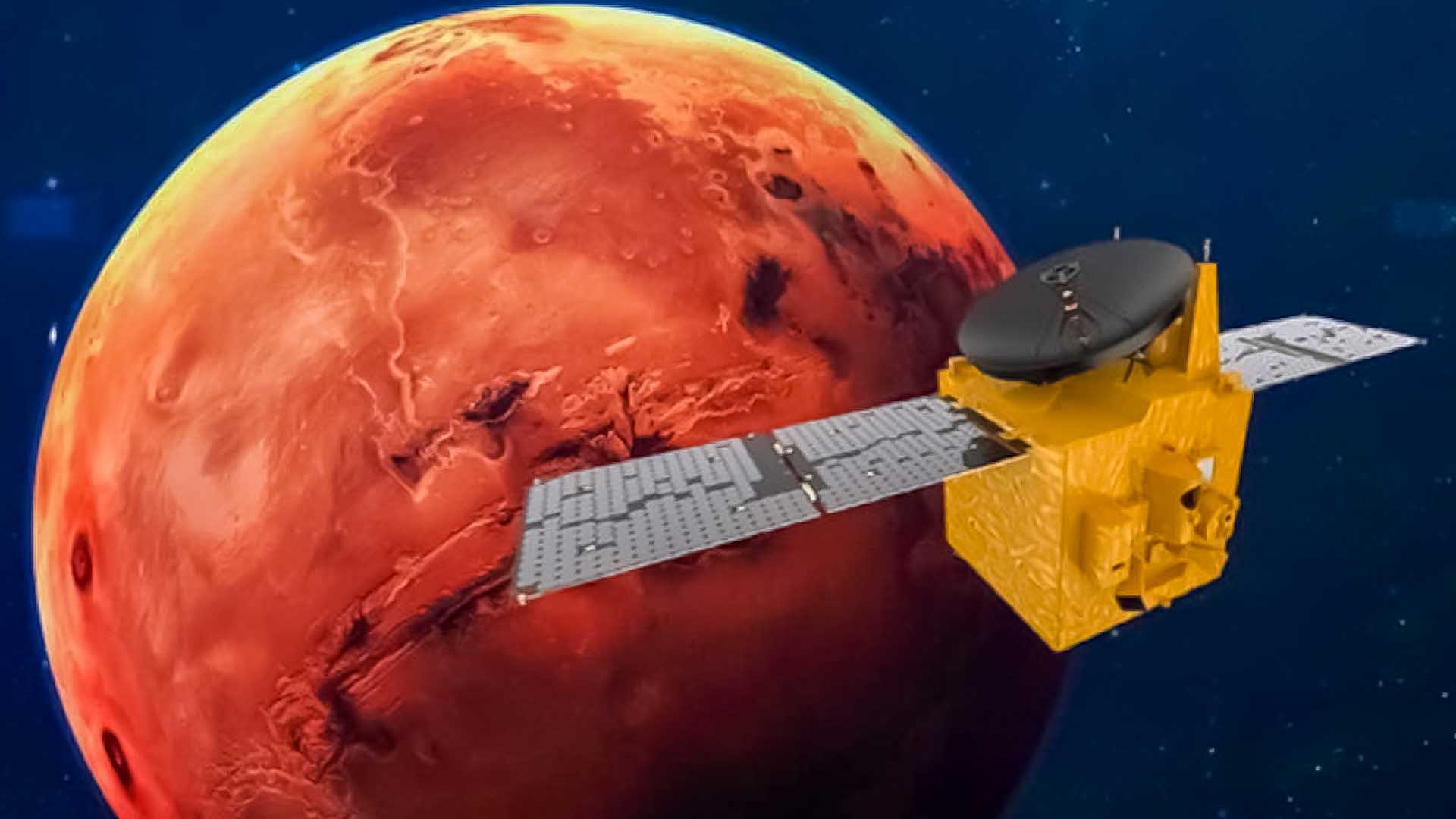
    Emirates Mars Mission discovers a new type of patchy proton aurora on MarsWhen the solar wind directly impacts Mars’ dayside upper atmosphere, it emits ultraviolet light as it slows down, resulting in this patchy proton aurora. The observation was made using snapshots of the dayside disk obtained by the Emirates Mars Ultraviolet Spectrometer (EMUS), which probes the planet’s upper atmosphere and exosphere for changes in atmospheric composition.

    Auroras appear as bright regions across the dayside of the planet at two ultraviolet wavelengths associated with the hydrogen atom: Lyman beta at 102.6 nm and Lyman alpha at 121.6 nm. At these wavelengths, the dayside disk of a planet is uniform, and its brightness is caused by hydrogen atoms scattering sunlight. During the aurora, small regions of the planet become much brighter at these wavelengths, indicating intense atmospheric energy deposition.

    A data sharing agreement between EMM and MAVEN allows analysis of new EMM images using plasma observations made by MAVEN, which has been characterizing the Mars ionosphere and magnetosphere since 2014. A full suite of plasma instruments was carried by MAVEN, including a magnetometer, 2 ion electrostatic analyzers, and other instruments that were used to measure Martian plasmas and fields during EMM’s observations of the patchy proton aurora events that occurred on Mars.

    Share. Facebook Twitter Pinterest LinkedIn Tumblr Email

    Related Posts

    MEAPMP Launches: Revamped Independent Ad-Tech & Premium Media Buying Across MEA

    November 3, 2026

    Sam Altman calls UAE most forward-looking country on AI

    November 3, 2026

    Apple iPhone Duo sets a new benchmark for foldable design

    November 2, 2026
    Latest News

    Egypt reserves climb $151.6 million to record $57.5 billion

    November 6, 2026

    Botswana diamond output rises 14% as economy shows recovery

    November 5, 2026

    Pune Metro Line 3 opens as Modi lays Phase 2 foundation

    November 4, 2026

    MEAPMP Launches: Revamped Independent Ad-Tech & Premium Media Buying Across MEA

    November 3, 2026

    Sam Altman calls UAE most forward-looking country on AI

    November 3, 2026

    OpenAI deals bring frontier AI to ADNOC and Abu Dhabi Government

    November 3, 2026

    Indonesia’s non-oil exports drive $10.61bn trade surplus

    November 3, 2026

    FirstRand joins African lenders eyeing Kenya bank acquisitions

    November 3, 2026
    © 2026 Tunis Network | All Rights Reserved
    • Home
    • Contact Us

    Type above and press Enter to search. Press Esc to cancel.